
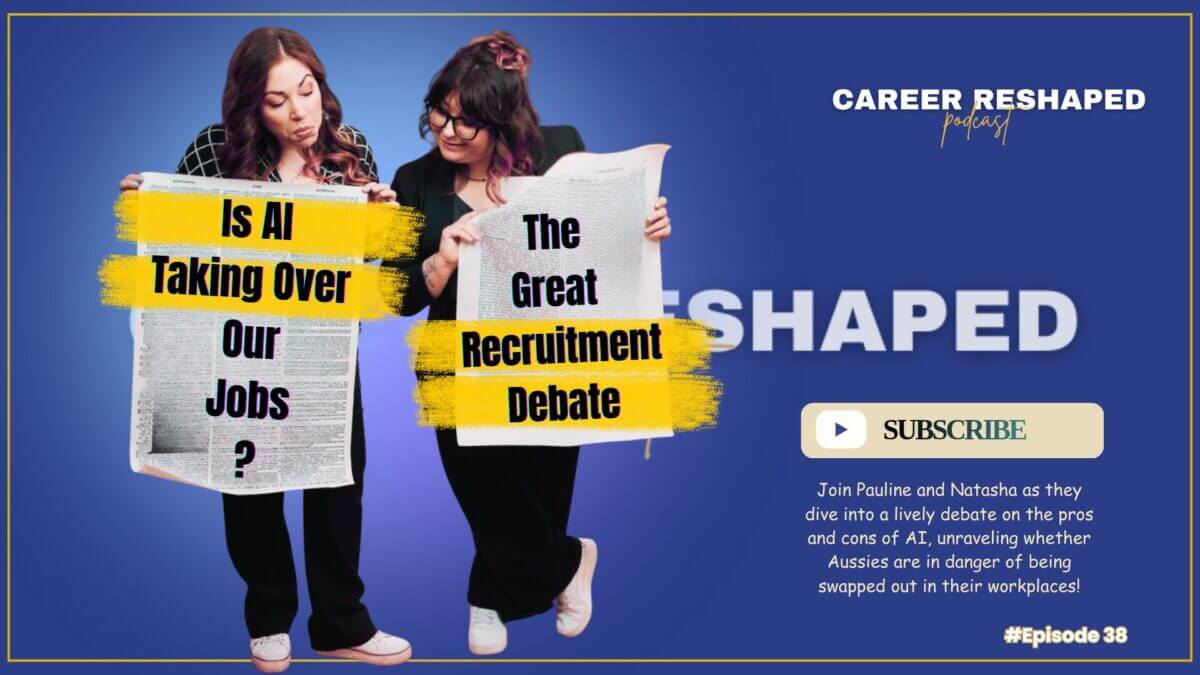
What if the biggest shift in recruitment isn’t about networking or polishing your résumé, but about how artificial intelligence is quietly changing the rules of the game?
In this episode of Career Reshape, Pauline and Natasha dive into the rise of AI in hiring and what it really means for Australians navigating today’s job market. They explore why companies are embracing AI tools, how it promises efficiency and fairness, and the serious concerns it raises around bias, cultural fit and the loss of human connection.
You’ll hear their take on whether algorithms can truly understand people, what happens when recruiters rely too heavily on technology, and how human roles in hiring are already evolving. They also discuss what skills—like creativity, emotional intelligence and problem-solving—will remain valuable in an AI-driven world, and why upskilling is becoming essential.
This episode is for anyone curious about the future of work, worried about AI replacing jobs, or wondering how to stay competitive as technology takes on a bigger role. Pauline and Natasha bring both sides of the debate to the table—what AI can do well, and where it falls short.
If you want a realistic look at how AI is transforming recruitment and what it means for your career, tune in for an honest and thought-provoking conversation.
🎧 Listen to learn how to adapt, what to watch out for, and how to protect the human touch in an increasingly digital job market.
| Time | Transcript |
|---|---|
| 00:08 | Hi everyone and welcome back to potentially a gamechanging episode of |
| 00:13 | Career Reshape. I'm Pauline and I'm Natasha and today we're tackling |
| 00:18 | a topic that's sparking a lot of discussion and frankly some concern in |
| 00:23 | the Australian job market. the rise of artificial intelligence in recruitment |
| 00:27 | and its broader implications for our jobs. |
| 00:32 | That's right, Natasha. So, from 5 screening resumes to conducting initial |
| 00:38 | interviews, AI is increasingly becoming integrated into the hiring process. And |
| 00:44 | while some hail it as a revolution in efficiency, others worry about its |
| 00:53 | potential impact on human connection and ultimately job security. That's |
| 00:58 | right. It's definitely a complex issue with valid arguments on both sides and |
| 01:02 | it's an argument that's been going on for a while. So, we want to talk about |
| 01:06 | it. Hey, thanks for watching. We'll be back |
| 01:08 | in 30 seconds. This is just a quick reminder to like and follow for more |
| 01:14 | content just like this. Let's start by looking at why companies are turning to |
| 01:20 | AI in recruitment. One of the biggest drivers is efficiency. AI algorithms can |
| 01:26 | process vast numbers of applications far faster than human recruiters potentially |
| 01:33 | saving time and a lot of resources and money. |
| 01:37 | Yeah, look, this is true. I can't argue there. AI can also help reduce biases |
| 01:44 | and in theory at least by focusing on skills and qualifications rather than |
| 01:51 | subjective factors that might influence human recruiters. This could lead to a |
| 01:57 | more diverse and more equitable hiring outcomes. And let's not forget the |
| 02:02 | potential for AI to improve the candidate experience. Chat bots can |
| 02:07 | answer basic questions instantly and the application process can be streamlined |
| 02:12 | through AI powered platforms. This is where I think I might debate |
| 02:18 | you, Natasha, if that's okay. Okay, go for it. Okay, so look, so on |
| 02:25 | the surface it does sound like a win-win, but here's where that |
| 02:30 | controversy kicks in. One major concern is the lack of that human touch. |
| 02:35 | Recruitment is about more than just matching key words on a resume. It's |
| 02:40 | about assessing cultural fit, personality, and those intangible |
| 02:45 | qualities that AI might, and I think really does struggle to evaluate. |
| 02:51 | That's a crucial point. And secretly I agree, but we're here to see both sides. |
| 02:58 | So, you know, can an algorithm truly understand the nuances of human |
| 03:02 | interaction and potential? There's a risk that they're relying too heavily on |
| 03:08 | AI, and it could lead to overlooking talented individuals who might not |
| 03:12 | perfectly fit in their predefined digital profile. They may have horrible |
| 03:18 | experience with writing a resume. Exactly. So another worry is the |
| 03:25 | potential for algorithm bias. Yes. So there is biases with AI. Uh so AI is |
| 03:34 | designed to be objective. The data it's trained and can reflect existing |
| 03:40 | societal biases. So that human bias still creeps in. Right? So inadvertently |
| 03:48 | perpetuating inequalities in the hiring process. So if the historical data used |
| 03:56 | to train AI reflects a lack of diversity in certain roles, then AI may just |
| 04:03 | continue to filter out diverse candidates. |
| 04:07 | Yeah. Ensuring fairness and transparency in a in AI recruitment algorithms is a |
| 04:14 | significant challenge that needs careful consideration and regulation. And if we |
| 04:18 | were going to go down a big rabbit hole, that could be through everything. |
| 04:22 | And the big question is what's the impact on human recruiters as AI takes |
| 04:28 | over more of the initial screening and administrative tasks? What will their |
| 04:32 | roles evolve to? Will there be fewer jobs for human recruiters in the long |
| 04:38 | run? And it's so weird saying human recruiters, but you have to now |
| 04:41 | differentiate between a human recruiter and an AI recruiter. |
| 04:47 | What's the world become? Um, but look, many experts believe that AI won't |
| 04:54 | entirely replace human uh but rather augment their roles. So |
| 05:03 | recruiters might shift their focus towards more strategic tasks like talent |
| 05:08 | acquisition, planning, employer branding and building those relationship with |
| 05:12 | candidates which is so important. However, this shift will likely require |
| 05:18 | recruiters to upskill and adapt to working alongside AI tools. And |
| 05:25 | honestly, that can be true for many industries and many roles. |
| 05:33 | Yeah, absolutely. And it's not just the recruiters that may be affected. As |
| 05:37 | you've just said, as I becomes more sophisticated, it could potentially |
| 05:41 | impact other white collar jobs that involve data analysis and pattern |
| 05:46 | recognition. So, you don't know exactly how far that will go. So, it definitely |
| 05:51 | is a broader concern that extends beyond just recruitment as mentioned earlier by |
| 05:55 | both of us. And I guess that's just something that's really on our mind when |
| 06:00 | we deal with, you know, all our clients and all the different roles that they're |
| 06:02 | in. It's a concern, but that's why understanding AI and the potential of it |
| 06:08 | is good for everyone just to see what they can achieve with it. We need to |
| 06:14 | have open and honest conversation about the ethical implications of AI in the |
| 06:19 | job market and how we can ensure a future where technology serves to |
| 06:25 | enhance the human capability rather than replace them entirely. This includes |
| 06:32 | discussions around regulations, ethical guidelines, and the need for continuous |
| 06:36 | upskilling and reskilling of the workforce. Now, I'm all for upskilling |
| 06:41 | and reskilling. I think learning should always um happen. We should always be |
| 06:46 | growing and evolving. But under what pressure? |
| 06:51 | So this is exactly why for you know for Australians it does mean staying |
| 06:56 | informed about the trends and proactively developing skills that |
| 07:00 | complement AI. So as I said before you know understanding how it could help |
| 07:05 | them and not take over. So thinking about critical thinking, creativity, |
| 07:10 | emotional intelligence, and complex problem solving. These are the human |
| 07:14 | skills that are likely to remain highly valued in an AIdriven world. Well, I |
| 07:21 | hope so because at the moment all I see is AI taking over creativity and |
| 07:27 | stopping people from thinking. But that's I guess maybe another topic |
| 07:31 | altogether. I guess it depends on what it is. if |
| 07:36 | it's simple tasks rather than big problem tasks. |
| 07:40 | True. True. So I guess look, is AI taking our jobs? I guess the answer is |
| 07:46 | likely more nuanced than the simple yes or no. It's certainly transforming the |
| 07:52 | job market and we do need to be prepared for these changes. You you can't hide |
| 07:58 | from it. The key is to understand the potential benefit and risks of AI and to |
| 08:05 | work towards a future where humans and AI can collaborate effectively. |
| 08:13 | Absolutely. We'd love to hear your thoughts on this controversial topic. |
| 08:18 | What are your concerns or hopes regarding AI in the job market? Share |
| 08:22 | your opinions in the comments below. If you found this discussion |
| 08:26 | thought-provoking, be sure to like this video and subscribe to Career Reshaped |
| 08:32 | for more in-depth analysis of the evolving Australian job landscape. |
| 08:39 | Thanks for watching and we'll join you in the next video. Bye. |

Take the first step toward a smarter, more effective job search with The Unseen Advantage. This ebook is designed for job seekers who are ready to move past outdated methods, create genuine opportunities, and position themselves as the candidate employers are looking for.
When you take time to reflect on your career and align it with your values, you’re not only investing in your own growth — you’re creating a ripple effect that impacts your family, your workplace and your wellbeing.
Whether you’re feeling stuck, ready for change, or simply craving more purpose in your work, Career Coaching can help you move forward with clarity and confidence.
Start your Next Chapter Today!