
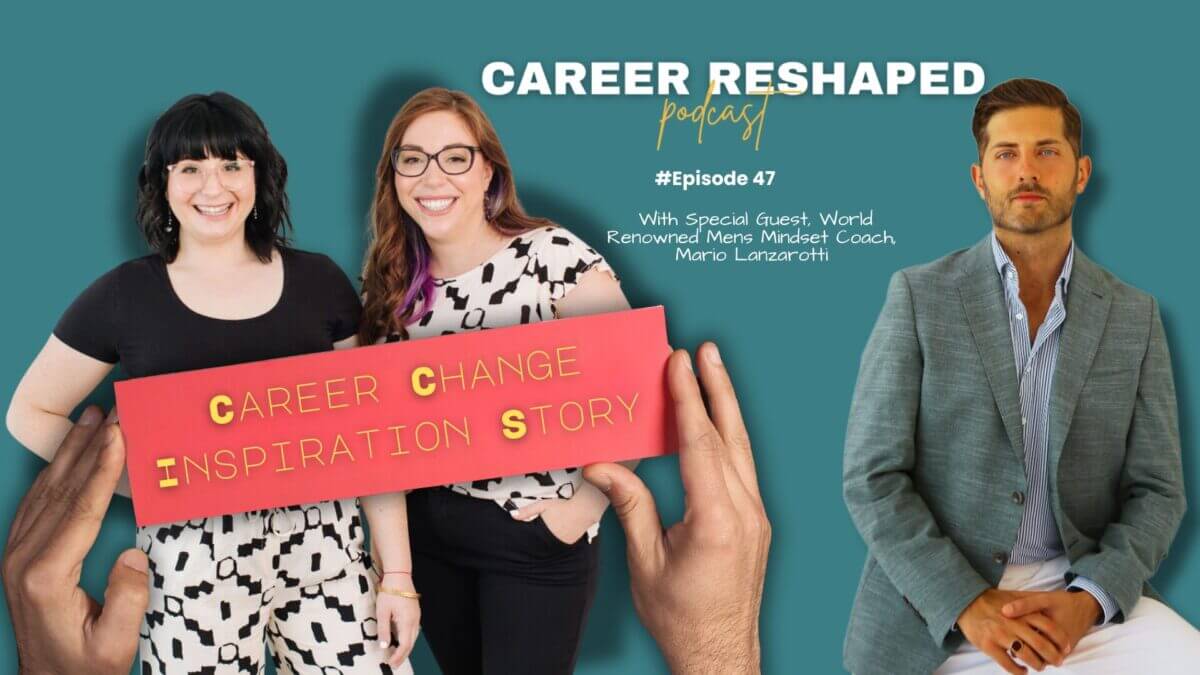
Ever wondered why so many professionals are quietly rethinking what success means today? You might be surprised at what is driving the shift.
In this episode of Career Reshaped, Natasha and Pauline sit down with Mario Lanzarotti, founder of Aligned Founders and a global leadership coach, to explore the real cost of chasing achievement without fulfilment. Mario shares how his journey from aviation to entrepreneurship to coaching reshaped his understanding of success, identity and personal growth.
From burning out in a career that looked impressive on paper to rebuilding his life through deep self work, Mario’s story reflects what many Australians are now experiencing. More people are prioritising clarity, purpose and wellbeing over titles, status and traditional measures of success. They are asking bigger questions about what a meaningful career really looks like.
For many professionals, the turning point arrives quietly. Stress that never goes away. A loss of passion. Constant pressure to keep pushing. Mario opens up about these moments, sharing how identity, self worth and unspoken expectations shape the work we choose and the work we eventually outgrow.
He also highlights the truth most of us avoid. Ignoring misalignment comes at a cost. Avoiding honest conversations makes everything heavier. Holding on too tightly can stop leaders from growing. His insights explain why so many Australians are pausing, reassessing and choosing careers that feel more aligned with who they are becoming.
Whether you are navigating burnout, considering a major shift or simply wanting more fulfilment in your day to day work, this episode offers a grounded and relatable look at how change begins from within.
If you have ever thought, There has to be more than this, you are not alone. Mario’s journey is a reminder that it is never too late to rebuild a career that feels clear, confident and aligned.
🎧 Tune in and discover how redefining success can reshape your life and career path.
| Time | Transcript |
|---|---|
| 00:01 | Hi and welcome to another episode of Career Res. I'm Pauling and I'm Natasha. |
| 00:07 | And today we have Mario Lensi who is the founder of Aligned Founders, a global |
| 00:13 | movement helping male founders transition from overworked operations |
| 00:17 | into aligned powerful leaders. He has coached more than 2,000 entrepreneurs |
| 00:24 | and reached 2.7 million and more views on his TED X. Mario shows founders how |
| 00:30 | to expand their capacity. So growth comes from clarity and confidence, not |
| 00:35 | ressure and grind. Thank you for joining us today, Mario. |
| 00:38 | Natasha, thank you so much for having me. Pauline, it's a pleasure to be here. |
| 00:41 | Looking forward for to the conversation. Same. We want to start with how your |
| 00:47 | career began. It began in aviation and as pilot traininee, which is super |
| 00:51 | exciting. What did that early career choice teach you about yourself? |
| 00:54 | primarily that success without fulfillment is no real success |
| 01:01 | at all. And that came because I chose this career path because I thought that |
| 01:08 | it would give me all the things that I felt I needed more of which was approval |
| 01:14 | from society, from my family, friends. It was a sense of status and power. you |
| 01:21 | know the the classical kind of male arc is you know if I have a great job you |
| 01:26 | know the women will come to me I'll have the money you know I I don't have any |
| 01:29 | problems in life that was sort of my very limited thinking at that time and I |
| 01:35 | found success in terms of I got what I thought I wanted and needed but it |
| 01:42 | didn't really give me what I actually needed which was more of like a true |
| 01:47 | sense of fulfillment a true sense of joy and passion |
| 01:51 | that I would experience on a daily basis, not at the end of some long uh |
| 01:57 | pursued goal or target. And you know that that career choice left me |
| 02:03 | completely am I allowed to swear here by the way? |
| 02:06 | Yeah. That career choice left me [ __ ] And I |
| 02:11 | you know I was depressed. I was burned out. I had suffered from chronic back |
| 02:15 | pain. um I was experiencing suicidal ideation and it really like completely |
| 02:22 | took away everything that I built my identity on and so it was extremely |
| 02:28 | painful but um I wouldn't want it to happen any other way and so I would say |
| 02:32 | yeah the greatest lesson was that success without fulfillment is no real |
| 02:36 | success right so I assume that is sort of what's |
| 02:39 | impacted your later career decisions and where you've gone from there |
| 02:42 | yeah totally because then I was like I burnt myself so hard. Now I really have |
| 02:48 | to reflect what it is that I actually want that, you know, isn't just ticking |
| 02:55 | the boxes in terms of money and status, but what is it actually that I |
| 03:01 | want? And that was a very hard question to answer because, you know, more I |
| 03:06 | think harder today than it was then because there's even more choices at |
| 03:09 | least from what we perceive because of the internet and social media. But for |
| 03:14 | me at the time, I remember I started watching YouTube videos from Tony |
| 03:19 | Robbins because I didn't really talk to anyone cuz I was too scared that if |
| 03:26 | I talk to people, everything will be worse cuz then everyone will judge me |
| 03:30 | and label me as an absolute loser. And this is the very much the male mentality |
| 03:34 | of when you're struggling, don't talk about it because then you're really |
| 03:38 | because then no one wants you any. You're useless. And so then I went |
| 03:43 | onto YouTube. I found Tony Robbins and it was just like, you know, it was like |
| 03:47 | the story in the in the Bible of the burning bush, you know, it's just |
| 03:51 | like, oh my goodness, it's like everything inside is like, |
| 03:56 | what is this thing? It's like I had never seen anything like it. You know, |
| 04:00 | coming from Germany also these kind of things, coaching, public speaking |
| 04:05 | were seen as like, you know, snake oil salesman kind of people. But I just |
| 04:11 | ignored all of that cuz I felt so connected. And when I saw Tony Robbins |
| 04:15 | change other people's lives and help them rebuild themselves, I was like, |
| 04:19 | That's it. That's it. I don't know how. I don't know when, but this is it. And |
| 04:25 | so I aligned my whole career choice towards hopefully one day me being able |
| 04:31 | to do exactly that. And I just let go of how it would happen. But I said, "Okay, |
| 04:37 | keep this in mind that one day you're going to be there." And that was an |
| 04:43 | incredible kind of experience that unfolded from there. |
| 04:45 | Wow. Awesome. So when you co-founded your New |
| 04:49 | York City startup, how did you view your career at that |
| 04:53 | point and how did it shift after this the exit from there? |
| 04:58 | Yeah, so I remember so I started out as an intern. I was studying in New York |
| 05:04 | and um part of the studies uh was an agreement that we had to do an |
| 05:09 | internship for three months and most of the students were going off to like |
| 05:14 | bigger agencies, bigger companies and I was like I know that when you work at |
| 05:18 | bigger companies you're often put into a corner office and giving a a stack of |
| 05:23 | things you know just work through that you know whatever and I was like I don't |
| 05:26 | want that. I want to work with a founder closely because then I'm going to I have |
| 05:30 | to work much harder. I know that, but I will learn way way way more. And |
| 05:34 | so at a trade show, I saw this guy, his name is Nick. Um, and he had his shoes |
| 05:39 | laid out there. And you know, I love shoes. Being half Italian, obviously, |
| 05:43 | it's part it's in my blood. I asked him everything about those shoes. He was everything about those shoes. He was |
| 05:47 | like, "Man, these are sexy." I was like, "Well, tell me about." And we started |
| 05:50 | talking and talking. I got I was really fascinated. He's like, and I asked him, |
| 05:53 | he's like, "Hey, do you by any chance like hire any interns?" And he's like, |
| 05:57 | Yeah, I I I actually need interns cuz this is a side gig that I have. I'm |
| 06:02 | working full-time. I was like, "Okay." So then we met up and I said to him, |
| 06:06 | Hey, look, I'll come on board as an intern, but only if you give me the |
| 06:10 | chance to become your co-founder. And he's like, "Okay, you've got balls. |
| 06:16 | Allow it. I don't know if you're talking [ __ ] or |
| 06:20 | if you're actually serious." So he said, "Sure, I'll give you a chance." I was |
| 06:22 | like, "All right, I'll prove myself." And I did. And I worked extremely hard. |
| 06:26 | And at the end of it, he said, "Okay, I'll make you my co-founder." And then I |
| 06:29 | told him one thing and I said, "Look, this is not going to be my ultimate my |
| 06:34 | ultimate focus." I said, "I want to be a coach and a speaker, and I want to do it |
| 06:37 | in the US because in Germany, there's no real market for this and people aren't |
| 06:41 | really open to it. So, the way that I |
| 06:43 | see this is my jumping board to that. And I will give you my absolute best. |
| 06:50 | I'm fully dedicated. I'm all in. And just know that one day I'm going to jump |
| 06:56 | off this this train and I need you to understand that this is not optional |
| 07:02 | that this is going to happen. So are you okay with that? And he said absolutely. |
| 07:06 | And he said how long do you think? I said I don't know. It could be 3 years, |
| 07:09 | 4 years, 5 years, but you know until then I am all in with this. And he said |
| 07:13 | okay great. And that's exactly what happened. Um, are you still, even though |
| 07:18 | you jumped ship, are you still co-founding with this guy with the shoes |
| 07:23 | or you've So, we sold the business after 5 years |
| 07:26 | in in business together. we sold the company and um yeah like we're still |
| 07:31 | we're still good friends you know I have very much have a have a a soft spot in |
| 07:35 | my heart for him you know because he went from boss to mentor to partner and |
| 07:43 | you know really learned so much because if him and gained access to an |
| 07:48 | incredible opportunity that would never been able to get if it wasn't for his |
| 07:52 | trust that he put in me. where you said earlier that you took this time off to |
| 07:58 | discover yourself or rediscover yourself. How long did it take? Like how |
| 08:03 | much time did you give yourself to do that? And did you put pressure like a |
| 08:09 | timetable on it or you just what comes come? |
| 08:12 | Yeah. Yeah, that's a great question. So I would say it was a mix of things. Now |
| 08:18 | when I quit my pilot career, I had I would say a year and a half or so |
| 08:24 | where I was just floating around doing a job here, a job there and then I |
| 08:29 | traveled. I actually left Germany. I went to South Africa and sort of like |
| 08:33 | spend a couple months there to just come back like emotionally, mentally because |
| 08:38 | I was in a very dark place. And after that I began studying fashion management |
| 08:44 | in Berlin. And that was sort of my I would describe it as my most hedonistic |
| 08:49 | time. Um where I was, you know, I was studying, I was I was doing some work, |
| 08:55 | but I was obviously also partying a lot and just letting loose. And for me, I |
| 09:00 | come from a background where I've always been very disciplined, very locked in, |
| 09:06 | and not really allowing myself a lot of leisure and just living life without a |
| 09:13 | specific fixed destination. And then when I graduated, I went to New York and |
| 09:20 | you know, it was hustle grind. It was six, seven days a week, just work, work, |
| 09:24 | work, work, work, work, work. and on the side in the I don't know how I did it |
| 09:29 | but like I've always managed to squeeze in some going to a seminar or doing like |
| 09:34 | a weekend uh thing or to train me in coaching to train me in leadership to |
| 09:38 | train me in mindset and psychology. I would coach a couple people here and |
| 09:43 | there you know I was just I was extremely locked in. I was very robotic |
| 09:47 | also like get up at 5, you know, go to bed at 10, you know, like d and I |
| 09:54 | pulled it off for a couple years, but again, it came at a great cost. And |
| 09:57 | then when I sold the business, I gave myself 6 months to figure this out. This |
| 10:04 | coaching thing, I was like, I'm not going to I'm have enough money to |
| 10:07 | survive, so I don't need to make anything for 6 months. I'm okay. And |
| 10:12 | then I just allowed myself to study, to learn, and I just and I took the |
| 10:18 | next couple years. I didn't focus it in a way where I'd say, "Okay, my goal now |
| 10:22 | is to build this super successful coaching and speaking business. I want |
| 10:27 | to become a great leader, a great coach. That's my goal." And so I invested |
| 10:33 | thousands, tens of thousands into trainings, coachings. I, you know, I |
| 10:39 | went I sat with shamans in the Amazon in Africa, you know, in North America with |
| 10:44 | indigenous tribes, you know, like I went to meditation retreats and |
| 10:50 | therapy, you name it. Like I did all because what I saw in the market, it was |
| 10:54 | like there's a lot of people that just slap a label onto themselves, say, "I'm |
| 10:58 | a coach now." and then they work with people on very delicate matters in their |
| 11:03 | lives and they don't really see the responsibility that comes with that and |
| 11:08 | said I don't I'm not going to do that. I'm going to walk the talk. And so the |
| 11:12 | first I would say three four good four years maybe even 5 years were focused on |
| 11:18 | my own healing on my own inner expansion. And it's been only the last |
| 11:23 | two years that I've been really focused on scaling my coaching business. and |
| 11:28 | that's where I'm at right now. That's amazing. Before you were saying, |
| 11:32 | you know, you're grinding and putting hard work. It's not the hard work is not |
| 11:36 | the issue. Is why you're working hard. What's the motivation? Cuz when it's |
| 11:40 | hard work for something that fulfills you, that's a joy all of a sudden. Like |
| 11:45 | that hard work fuels you or feeds you to keep going. Cuz you were saying you're |
| 11:51 | working six, seven days a week and you still added more hours to your day. a |
| 11:55 | little sleep, travel, trying to meet with the right people. I mean, that |
| 11:58 | could burn you out as well, but it didn't because you were actually doing |
| 12:02 | something that fed your soul and you kept going. So, it's not hard work. It's |
| 12:08 | where or the motivation, the reason why you're working hard is what's essential |
| 12:13 | here. And like you were saying before, people are trapped doing what they think |
| 12:18 | society will approve of it rather than what they feel is true for them. So I |
| 12:25 | think it was amazing. So I think I know the answer based on |
| 12:28 | what you've just said, but I'd like to know what was the most challenging |
| 12:33 | career transition from you cuz you started with the pilot training and |
| 12:36 | everything and moved to a co-founder but then founder to co. What was the hard |
| 12:42 | part or were they equally as hard? That's a great question. So I would say |
| 12:47 | becoming a founder for the first time and then now having to manage lead |
| 12:54 | people and I went from being an intern to all of a sudden servicing |
| 13:00 | multi-millionaire and billionaire clients. We had two billionaire clients, |
| 13:05 | very famous people. One of them I'm not allowed to disclose cuz I had to |
| 13:09 | sign an NDA. But the other one was the C the CEO of Google still today. Sundar |
| 13:14 | Pinchai, he was one of our clients and you know NFL Super Bowl champions, |
| 13:20 | Seattle Seahawks, celebrities, A-listers, these kind of people. And I'm |
| 13:25 | like, here's a guy comes from like a tiny ass village in Germany. |
| 13:28 | How do you talk to them? Exactly. And it's like it's like oh |
| 13:32 | okay. Um these guys make more money than my entire generation has made, so to |
| 13:38 | speak. And now I'm selling shoes to them and I'm and I'm like okay like how do |
| 13:44 | you make that shift in in terms of confidence? So there was you know |
| 13:47 | impostor syndrome you know there was a lot of self-doubt. There was a lot of |
| 13:51 | like I'm I don't I don't even fit in here. I had an accent when I first |
| 13:57 | started out because my first language is German. My second is Italian and my |
| 14:01 | third is English which is you know school but mostly self-taught. And so |
| 14:08 | there was there's just a lot that I had to deal with. But then I would say when |
| 14:12 | I went through that then and then transitioned into coaching now in in in |
| 14:19 | coaching it's a fine element here is because I'm not just a coach also a |
| 14:23 | speaker is when you're a speaker you're sort of the center of the stage. |
| 14:28 | everyone looks at you, you know, they're looking at you, but as a coach, you have |
| 14:32 | to remove yourself as much as possible because you have to make space for that |
| 14:37 | person for their uniqueness to shine through. So, there's a lot of |
| 14:42 | identity shifting that that that takes place and that sometimes that's just |
| 14:47 | like who the [ __ ] am I? It's like how do I |
| 14:50 | navigate all that? So I would say so I would say it's that and then you know I |
| 14:54 | have another coach that works for me in in my company and I'm looking to |
| 14:58 | bring on more and there's now this sense of like okay |
| 15:03 | training people in my methodologies and then trusting them with something that's |
| 15:08 | so sacred to me when I coach another human being is like I'm giving them |
| 15:13 | everything and I'm making sure that it's a very safe container with them and I'm |
| 15:17 | trusting other people to do that under my name. And it's like, okay, that's |
| 15:22 | fluorite, you know, that's another sort of transition. So, I'd say those were |
| 15:26 | the main ones that the hardest ones that have been facing. |
| 15:30 | Thanks for watching. We'll be back in just a moment. This is just a quick note |
| 15:34 | to let you know this is part one of a three-part series with Mario. |
| 15:40 | Interesting that you've mentioned that because Pauline and I have also been |
| 15:43 | talking the when we want to expand or get bigger and you know that's |
| 15:48 | obviously always the goal to make sure they do it with our touch the way we |
| 15:53 | envision it and because we do things in a very holistic approach and really get |
| 15:58 | to know our clients really well and understand really what their desires are |
| 16:02 | and what their vision is for their careers and |
| 16:06 | not a lot of I mean I'm sure there are other coaches that do that but It's how |
| 16:09 | we talk to them and our personalities come out. So I understand that probably |
| 16:14 | a fear that you had of how is this coach going to implement my teachings and |
| 16:20 | replicate and do the same thing. It's also about letting go. I don't ever |
| 16:25 | want to give anything away. It's all mine. my not in a greedy way, in the |
| 16:29 | way where it's like, well, I'm going to do this task and this task and this task |
| 16:33 | and this task and I don't trust anyone else to do it, so I'm just going to do |
| 16:38 | it all. I rather stay up. I rather work on the weekends, work late at night, but |
| 16:42 | it's going to be done my way. And that's where the control is. It's my way. And I |
| 16:46 | keep having to remind myself that just because it's not my way doesn't mean |
| 16:50 | it's not still not a good way or maybe even a better way. So, it's a it's hard. |
| 16:55 | So, how did you do it? How did you let go? |
| 16:59 | Yeah. So, that's a great question and I always bring in the same analogy |
| 17:03 | whenever I get asked this question because it's analogy that makes so |
| 17:07 | much sense. So, this is my cup of tea right now. |
| 17:11 | I can It's lukewarm. So, but I have a bunch of fresh tea here on the side |
| 17:17 | which is pretty hot. So, if I pour it in here, how much longer do you think I |
| 17:22 | could hold on to this cup in the way that I'm holding it? |
| 17:24 | Your hand burns. Yeah. So I would drop it very quickly |
| 17:30 | and that analogy is the letting go process. It's like, you know, Pauline, |
| 17:35 | what you just shared is the sense, this is very common among founders, among |
| 17:39 | leaders, and I faced it myself, is the sense of like, yeah, but no one can |
| 17:43 | really do it like me. And then when you're when you're using that mentality |
| 17:49 | and you couple it with a fear of other people making mistakes, which you cannot |
| 17:56 | control cuz it's out of your control whether they make a mistake or not. Now |
| 18:00 | you are very likely not to give people a lot of chances. And think about it in in |
| 18:05 | in in this way. When the reason you came to do things as good as you do them and |
| 18:11 | the way that you trust them, you had to go through a lot of mistakes. |
| 18:16 | You made tons of mistakes and you learned from all those mistakes. That's |
| 18:20 | how you get better. That's literally how any human being gets |
| 18:24 | good at anything in life. And so what I would suggest is you have to grant a |
| 18:29 | tolerance for mistakes to people that you want to take over work that you're |
| 18:34 | doing right now. And if you're not doing that, and this is where the analogy |
| 18:40 | comes in, if you're not doing that, you're holding on to a cup that's |
| 18:43 | already burning your hand because you become the bottleneck of the business. |
| 18:48 | You become the bottleneck of the section within your team. And that means that no |
| 18:54 | amount of strategy, no amount of hours that you're adding to your plate is |
| 18:58 | actually going to move the needle. That's very true. |
| 19:01 | Good analogy. It's definitely food for thought. So, |
| 19:04 | yeah, looking back, so we've gone into a bit |
| 19:07 | of detail now about your career and how you've gotten to where you are. |
| 19:12 | What's one career lesson you wish you had learned earlier? have hard |
| 19:18 | conversation often and quickly. Like this is probably the one thing that I |
| 19:25 | see derail any company. Like if I had to bring it down to one thing, it's that |
| 19:31 | because when so often we avoid communicating |
| 19:36 | our needs and our desires. And so within a company, if you don't communicate to |
| 19:43 | like take the two of you, right? you run this podcast together, you know, you |
| 19:48 | you work together. Like if Natasha has something that she isn't happy about |
| 19:55 | the way that Pauline is doing it, but then goes, "Ah, whatever. It's not a |
| 20:00 | biggie." You know, just put it to the side. You're adding it to like a little |
| 20:05 | little mountain of resentment. And that mountain can be tiny, which is which is |
| 20:10 | fine. But often times what I've seen it, it ends up growing. It ends up growing. |
| 20:15 | it ends up growing. And the more this mountain of resentment grows, the more |
| 20:20 | trust breaks apart between the two of you. And when trust breaks apart between |
| 20:25 | two people, collaboration starts to break apart. And now that means you |
| 20:30 | start to withhold from each other. And so when you're withholding now, one of |
| 20:36 | you or both of you take on too much work and you're doing things that you're not |
| 20:40 | supposed to be doing, which means now you're wasting your time, your energy on |
| 20:46 | activities that don't move the needle. And the same is true for employees, |
| 20:52 | right? I had a I had a I have a client of mine who's been struggling a lot with |
| 20:58 | leadership because he's been falling into people pleasing tendencies. And so |
| 21:03 | he's had two times before I came in where one of his employees thought that |
| 21:10 | he was some somehow his co-founder. And I was like, "Did you ever give them |
| 21:15 | a contract or tell them that they the co-founder?" And he's like, "No, I never |
| 21:18 | did that." And he said, "But they just keep like keep speaking over him." |
| 21:22 | He's like, "How does that work?" And so then I looked at his leadership style |
| 21:25 | and he's like, first of all, he's always trying to be the nicest guy. It's like, |
| 21:29 | Hey, you know, it's okay. It's the deadline. You know, we'll make it work. |
| 21:33 | You know, don't worry about it. And I ask him, "How do you actually feel about |
| 21:37 | this person?" He's like, "You know, I'm just so [ __ ] angry. I'm |
| 21:41 | so angry." I'm like, "H, that doesn't come through when you speak, though. |
| 21:45 | It's always smiling and thumbs up." It's like, "How come you're not saying |
| 21:49 | anything?" And so, this is what I mean. is like you're avoiding a hard |
| 21:52 | conversation because a lot of people are afraid of confrontation because |
| 21:56 | confrontation brings up rejection and rejection brings up, oh, I'm not good |
| 22:02 | enough or it brings up loneliness. And so these are the things that we try to |
| 22:06 | avoid. But I would say my number one career lesson for me is have hard |
| 22:11 | conversations fast and have them often. Number one, it makes you a much more |
| 22:17 | powerful leader. Number two, it just removes conflict as it starts, not when |
| 22:22 | it's too late. And it creates a culture of openness where people feel safe |
| 22:27 | enough to express their ideas, their concerns, and that just creates an |
| 22:31 | amazing work environment. |



Take the first step toward a smarter, more effective job search with The Unseen Advantage. This ebook is designed for job seekers who are ready to move past outdated methods, create genuine opportunities, and position themselves as the candidate employers are looking for.
When you take time to reflect on your career and align it with your values, you’re not only investing in your own growth — you’re creating a ripple effect that impacts your family, your workplace and your wellbeing.
Whether you’re feeling stuck, ready for change, or simply craving more purpose in your work, Career Coaching can help you move forward with clarity and confidence.
Start your Next Chapter Today!