
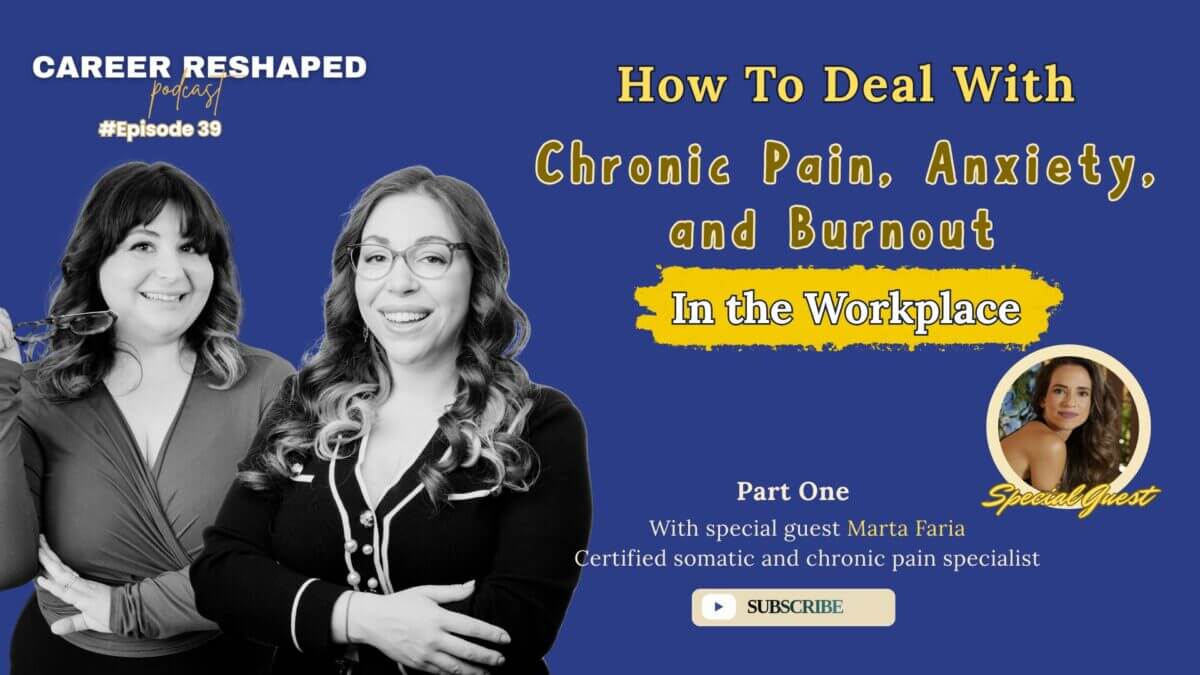
What if the real barrier to your career growth isn’t your résumé or skills, but your nervous system quietly working against you?
In this episode of Career Reshaped, Natasha and Pauline talk with Marta Faria, a certified somatic symptom and chronic pain specialist. Marta explains how stress hides in the body, why high achievers often miss the warning signs, and what simple resets can restore balance.
They explore how waking up at 3am, snapping at small things, or dragging through the day—even after sleep—are signals your system is stretched too far. Marta shares a 60-second desk reset, the difference between fast and slow breathing, and why habits like perfectionism, overworking, or hyper-independence aren’t personality traits but stress responses.
You’ll also hear how chronic stress affects digestion, immunity, and long-term health, plus why guilt around resting often comes from deep-seated beliefs about laziness and success. Marta unpacks how to shift those patterns, why “wellness” shouldn’t feel like another hustle, and what daily practices can help you rewire your system.
This episode is for anyone who feels constantly “on,” wonders why rest feels uncomfortable, or wants to prevent burnout without losing their drive. Natasha and Pauline guide an honest, practical conversation about nervous system health, career alignment, and the invisible habits that can either hold you back—or help you thrive.
🎧 Listen in to learn how to spot the hidden signs, use small daily resets, and reclaim energy and resilience for both your career and your life.
| Time | Transcript |
|---|---|
| 00:00 | Hi and welcome to another episode of Career Reshaped. I'm Natasha |
| 00:07 | and I'm Pauline and today we have Marta Faria with us. She is a certified sematic symptom and |
| 00:12 | chronic pain specialist and the creator of the 12week revive and thrive program. |
| 00:18 | a nervous system centered framework that helps high achieving professionals resolve stress related symptoms like |
| 00:26 | burnout, IBS, fatigue, migraines, and chronic pain. With a background in |
| 00:31 | events management and a personal journey through burnout, Marta now supports clients worldwide to rewire their |
| 00:38 | nervous system, restore resilience, and reclaim joy in their lives. Thank you for joining us, Marta. |
| 00:44 | Welcome. I'm happy to be here. Thank you for having me. So, I'd like to start off by asking you, what's one physical or |
| 00:50 | emotional sign someone is living outside their nervous system's window of tolerance? |
| 00:55 | Right. There are a few signs. I would say that the most common one is when people start experiencing insomnia, when |
| 01:02 | you wake up at 3:00 a.m. and you cannot sleep or if you were not having insomnia |
| 01:09 | yet. So when people are working you know like when you are really irritable when you start to get annoyed by little |
| 01:14 | things I often say to people it's it's never about the little things there are |
| 01:20 | things underneath it's often because your cup is getting full and then you start getting you know like that levels |
| 01:27 | of irritability and you you just feel out of balance. So if you are if if you |
| 01:32 | are feeling constantly tired there is a difference between that level of exhaustion there's there is fatigue but |
| 01:40 | you know like when you know you sleep and you wake up and you are dragging so those are all signs of a nervous system |
| 01:47 | that is that is disregulated. I feel really seen right now. Oh no. Oh |
| 01:54 | no. There's um I got bells alarm bells. I want to finish this now. No, I don't |
| 02:00 | want to know anymore. You can help us right now. Which maybe you can. Can you share a 60-second sematic reset someone |
| 02:07 | can do at their desk and maybe we could do it right now together? Yeah. Like uh what we can do especially |
| 02:13 | like if you if you are in the office and there's a lot of people there uh it's |
| 02:18 | you know I feel like a lot of people like to be discreet about it. So the best way if you are at your desk just |
| 02:25 | take long deep breaths and like bring to the diaphragm, bring to the belly and |
| 02:30 | breathe slowly. We'll be back in 10 seconds. |
| 02:36 | This is a friendly reminder that this is a part one of a part two series with |
| 02:41 | Marta. So if you don't want to miss out and learn even more, then subscribe and |
| 02:47 | follow. And as you do the idea is that you don't look at your screen but you |
| 02:54 | start scanning the rooms. It's a technique it's called orienting. So what you do you just bring your gaze and just |
| 03:03 | have a look around very slowly and you can look up or down and right and left |
| 03:08 | and really pay attention to colors. Pay attention to details and as you do |
| 03:13 | breathe really deeply. What that does, it kind of tricks the brain a little bit because when we uh if there is a threat, |
| 03:23 | when we feel fearful about something, if there's something going on, often the |
| 03:28 | focus of our attention goes into that thing. So we become very like narrow. So |
| 03:33 | for example, if you are working on a project and you are tense and you know maybe something that you're trying to |
| 03:39 | figure out or you are experiencing some setbacks and things are not you know working so your attention is going to be |
| 03:46 | really focused and you were here. So that signals the the nervous system that |
| 03:52 | there is a threat. So that activates the sympathetic nervous system. So what the orienting does it signals that |
| 03:59 | everything is okay because we only gaze and look around and you know and take |
| 04:05 | our time when things are peaceful when things are nice. So if you do that and |
| 04:10 | just take five minutes to breathe deeply abdominal breaths and look around and |
| 04:17 | you can tell yourself it's fine just decompress that is something I can do in the office |
| 04:24 | through your nose. Does it make a difference? Cuz I know like when um I did a breath work class, they said, "Oh, |
| 04:31 | you know, breathe through the nose but out through the mouth." I'm not Does that make a difference? If it's through |
| 04:37 | the mouth, nose or It depends on what you want to achieve. So breath like there are many different |
| 04:44 | types of breath work. They will do different things, but like essentially you have two types of breath work. one |
| 04:51 | that it's going to help you to release the excessive amount of carbon dioxide |
| 04:57 | and those ones are you know like rapid breathing. So if you do this rapid breathing that you inhale through the |
| 05:05 | nose and exhale through the mouth as you were describing. So those those are really good to boost |
| 05:11 | energy. They will give you energy. They will help you with mental clarity. Whereas these slow breaths bringing it |
| 05:18 | in and out through the nose very slowly those ones are to calm down the nervous |
| 05:25 | system. Those ones are the ones who will activate the the parasympathetic nervous |
| 05:30 | system. Another very common slow breath that is uh especially popular in the |
| 05:35 | yoga studio is is the na sodana which is the nostril of varation. So you breathe |
| 05:41 | in through one nostril and you exhale through the other. So that has a calming effect on the nervous system as well. |
| 05:49 | That one already so many things exciting to try. Yeah, I've already breathing. So whenever I felt anxious, I |
| 05:57 | would do that. But it's good to know alternative options and it seems a lot |
| 06:02 | more peaceful with box breathing as well. Yeah. And you can do when you are anxious or you can just start your day |
| 06:10 | with a practice with a somatic practice or a breath work practice because that is going to help you not to feel so |
| 06:18 | stressed not to feel so anxious. So it's it's better to do before you're anxious |
| 06:24 | than when you are in that state because sometimes depending on what you're going through it's very difficult to switch |
| 06:30 | off but the practices can help. You do five minutes and you begin to to relax. |
| 06:36 | I like that. It's a good way to start the day. What are the most common invisible symptoms that high achievers normalize |
| 06:43 | but really shouldn't? Right. So, there are some behaviors that you know can lead even to to burn out. |
| 06:51 | And those are things that sometimes are even mistaken by a personality trait. |
| 06:57 | So, for example, perfectionism. Some people might say, "Oh, I'm a I'm a perfectionist." as if this was part of |
| 07:04 | their personality, but it isn't. It's it's a subconscious loop. It's a trauma |
| 07:10 | response. So, this was the child that was being praised only when they were |
| 07:15 | doing everything right and could have many reasons and no one size fits all. Like, I don't like to say, oh, this is |
| 07:21 | necessarily because of that. So, we need to look individually, but often |
| 07:26 | perfection isn't control. people who go a lot into micromanaging or they find |
| 07:32 | very difficult to delegate. So sometimes is the people that have the perception |
| 07:37 | the unconscious perception that they need to solve everything. They don't like to ask for help. For example, there |
| 07:44 | is the hyper independence and that leads to that these people that oh no no no I can handle I can handle but then again |
| 07:50 | your cup is getting full and you are not asking for help until the point that you |
| 07:56 | collapse over productivity like this term people don't use very often anymore |
| 08:02 | which is the workaholic. Yeah, we live in such a hustle culture that praises so |
| 08:07 | much. You know, the ones that arrive earlier and leave late and are constantly there working. Uh some people |
| 08:15 | can actually handle so many hours but that is a form of distraction as well |
| 08:22 | because you by doing that you don't need to sit with your emotions. You don't need to sit with what is coming up. I've |
| 08:29 | seen people going through deep uh grieving periods for example you know even in the face of the loss of a loved |
| 08:35 | one which is something very justifiable for you to take some time off and some people are like no no no no I can't I |
| 08:42 | need to keep going because I you know I don't want to feel the sadness I don't want to grieve I just keep going |
| 08:50 | they tell themselves that it's uh going back to work is the best thing for them |
| 08:55 | to keep their mind off of it so they don't have to think about it I I personally know people that have said |
| 09:00 | those words. No, work is the best thing for me. Yeah. Yeah. |
| 09:06 | It's crazy. I mean, I understand on one hand cuz I would also understand not wanting to |
| 09:12 | think about it, but I also believe the importance of feeling it and getting |
| 09:17 | through it. My auntie is a good example of that. She's one of those people like high achiever and constantly doing doing. And |
| 09:26 | I remember when my cousin unfortunately passed away in a motorbike accident. I |
| 09:31 | feel like for her it was just so you know like you know as a mother if you have kids you know right losing child |
| 09:39 | possibly the worst thing in the world that can happen to to to a human being. |
| 09:44 | But she she opened a business like right after and I said to her I was like you |
| 09:50 | are escaping. And she's like, "No, no, no, no, no. Life goes on and now she has |
| 09:55 | fibromyalgia." Yeah. And it started a few months later |
| 10:00 | ecause that has nowhere to go and it's too deep. But you know, |
| 10:07 | No, no, no, no. For me though, sometimes it's hard to concentrate on anything else other than |
| 10:13 | he problem. Even at work, I can't focus. I can't even enjoy the things that normally calm |
| 10:20 | me down. if I'm that upset. It's also hard to be distracted at the same time. |
| 10:25 | Everyone's different. Yeah, it's good to find a balance. It's good to allow yourself time, but obviously, yes, you could not become |
| 10:32 | obsessed about it as well. So, of course, you need to to to focus on other things as well. But it's very important |
| 10:39 | to allow the emotions to just arise. And it's not easy to go through them. I feel |
| 10:45 | like, you know, in the in the healing journey, this is the hardest part. It's always to to feel our emotions because |
| 10:53 | you can do the the somatic practice, you know, the nervous system work and you can do the breath work and tapping and |
| 10:59 | shaking. There are so many techniques and they are very helpful but ultimately |
| 11:04 | you need to process your emotions because the nervous system react simultaneously immediately. So that is |
| 11:11 | the the the central of the healing journey is to process your emotions. |
| 11:17 | Yes. probably because if you keep running away from it, it's eventually going to keep catching up to you. Some |
| 11:23 | of our clients, they some they have to leave their job for whatever reason and it's an emotional exit and they're so |
| 11:30 | upset. It's like a knee-jerk reaction that they have to quickly find something else or or get something else that's |
| 11:37 | on. as instead of processing what's happened, calming down, thinking about the next |
| 11:45 | step in their career, it's no, no, no, I got to quickly solve this problem and and get another job. And I feel that |
| 11:52 | they're never going to be 100% fulfilled because they're they're making decisions |
| 11:57 | based on emotions rather than actually feeling what is right for them in like I |
| 12:04 | don't know what's the word. Absolutely. So they keep out of alignment. So they are Yeah. That's what |
| 12:10 | happens when you take decisions based on fear. Yeah. So what is running the show is |
| 12:15 | like okay I cannot have this space. I need to work. Yeah. I think like most of us were |
| 12:22 | conditioned that success comes through hard work. Yes. We never really learned that |
| 12:29 | alignment and when you know like to listen to the body what feels good in the body often is what is pointing us |
| 12:35 | into the right direction. The body is is something that measures everything. You know, like sometimes we look, you know, |
| 12:42 | when I get that feeling, I knew it. I knew there's something wrong. I cannot put my finger on it. But you kind of |
| 12:47 | know it. And that is the body response. But many times we completely ignore it and we go |
| 12:57 | into the logical mind that is racing fear and like, "No, but I have bills to |
| 13:02 | pay and there's that and such and such." And that's exactly what you said. Then the person after a while is not really |
| 13:09 | fulfilled. But it's not because you know when you had a chance to pause, you just didn't just jump straight into the next |
| 13:17 | thing. So you touched on it a little bit. You started to talk about um your auntie and |
| 13:24 | the fibromyalgia. So could you explain the connection between the nervous system and the chronic symptoms that can |
| 13:32 | come up like that or IBS or migraines or anything along that line? |
| 13:37 | Yeah, sure. So what happens is uh so what people need to understand about the |
| 13:42 | nervous system is you know we have the sympathetic one and the parasympathetic one. The sympathetic nervous system is |
| 13:49 | the fight orflight one and the parasympathetic is the rest digest. |
| 13:54 | Right? And ideally we should spend 70% of our time in the parasympathetic |
| 14:00 | nervous system. It's called rest digest for a reason because your body needs to be calm for those things to happen |
| 14:07 | properly within us. Right? But what is happening to us is that our sympathetic nervous system is really active most of |
| 14:14 | the time because we as humans we don't respond just to the immediate threat we |
| 14:22p | roject. So anxiety for example is a projection of the mind to something that |
| 14:28 | can go wrong. So it's not something that is threatening you right now but it's |
| 14:33 | the possibility of things going wrong and we often we start ruminating about |
| 14:39 | pain or when you have an argument with someone and you know the tendency to blame and to be right and then you just |
| 14:46 | replay that in your mind over and over again. So all of those things make our |
| 14:52 | our sympathetic nervous system be active. But what that does is that your |
| 14:58 | blood flow starts to go to the muscles and not to the brain anymore, not to the organs anymore. Um you have a spike and |
| 15:07 | you just release a lot of cortisol, a lot of adrenaline. And those hormones, |
| 15:12 | they are not bad for you, they are necessary. So you produce cortisol every day in the morning to wake up. For |
| 15:18 | example, the sunlight allows us to produce that. But when that is excessive, it starts to mess with the |
| 15:26 | your your entire body chemistry and that will lead to inflammation. And |
| 15:32 | inflammation is is the cause of 90% of all disease. So when that happens, if |
| 15:38 | you are constantly in the sympathetic nervous system, your immune system is going to slow down. Like so many things |
| 15:46 | happen in your internal pharmacy in your body chemistry that this eventually |
| 15:51 | leads to disease. And another thing is like each of us will tend to tense a different part of the body. So obviously |
| 15:57 | when we are in high alert you know you might be aware of it or not but you are |
| 16:03 | contracting. Yeah. You start experience a lot of muscle tension and some people |
| 16:10 | for example like pelvic floor. I was talking to to a doctor the other day and she was saying, "Yeah, people do this |
| 16:17 | unconsciously because some people when they feel their emotions is the the the |
| 16:23 | lower part of the abdomen that contracts and they don't even notice." But this is a it's an unconscious contraction |
| 16:31 | uh that it's happening there. So if that organ is being constantly receiving that |
| 16:37 | contraction, so there is not enough blood flow, everything gets blocked there and then it leads to disease. |
| 16:44 | Wow. It's scary actually. But it all makes sense. It it it it actually really cuz the body really is |
| 16:52 | quite I don't want to say magical but it it everything leads into everything and |
| 16:57 | it it's affected in every single way. And the really good doctors that I have had, western medicine even always say |
| 17:05 | stress and gut like it's you got to figure out what's going on there. Fix that first. Get that balanced and then |
| 17:12 | you can go and expand further. And especially those in you know naturopaths |
| 17:18 | and kinesiologies and I even had my daughter speaking with a um speech |
| 17:24 | therapist recently. Not that she has an issue with her speech was to do with her jaw and her teeth. But she was one and |
| 17:30 | she even said first thing get the gut sorted from the gut sorted it will help |
| 17:37 | with nasal with nasal then it will help with everything else around the face and it's just it's all connected. Impressive |
| 17:44 | a lot of skin conditions are related to the gut for example. Yeah. Absolutely. |
| 17:50 | And I and I say that to people if you have a digestive problems then okay first you look into diet because |
| 17:56 | obviously if your diet is not good you know you need to start through the diet but when you have a clean diet and the |
| 18:03 | problem persists then it's already a sign that the problem is not diet but the problem is the nervous system |
| 18:09 | because again rest digest but if that is too active you are not going to digest |
| 18:15 | properly. the digestive system begins to fail if we are constantly in a state of |
| 18:21 | stress and people eat even you know in front of the screen which is not good for them but it's so normalized in the |
| 18:29 | the corporate world I just think that a lot of the symptoms |
| 18:34 | that you describe I think let's just say you take it to a doctor I'm feeling this |
| 18:40 | I'm feeling that they kind of dismiss it a little bit they do blood work like your blood works It's fine. You're fine. |
| 18:47 | Um, you're not fine. And then you start to think, okay, well, what else could it be? I know that I'm like, well, well, |
| 18:53 | look, I'm tired. I've got dry skin. I'm irritable. I don't sleep well at night. |
| 19:00 | Oh, I must be going through per menopause cuz I'm 42 years old. That |
| 19:05 | makes sense. And then you talk to someone else like, well, you're bit young for permenopause. |
| 19:12 | Well, what else can it be? And I am always stressed. Like I'm I'm a very |
| 19:17 | anxious person naturally. I always worry. I'm always in my head. Never do I |
| 19:22 | think that any of these symptoms are related to my nervous system. Never did |
| 19:28 | to consider that because stress has become such a normal part of my life |
| 19:33 | that I actually don't know what it would be like not to be stressed anymore to be |
| 19:39 | honest with you. Uh yeah and I I can relate Pauline because I I used to |
| 19:45 | struggle with anxiety as well but sometimes it's just so normal that you don't even realize it took me it took me |
| 19:52 | years to realize that I had an anxiety problem you know it just I wasn't even thinking about that you know you you get |
| 19:58 | on with life and you are working and you know we get used to stress and you know |
| 20:04 | when we are this person yeah like I I have always been like this. Yeah. So, |
| 20:11 | you know, it's not that you are an anxious person. Again, let's be careful how we frame that because you were |
| 20:16 | putting that in your identity, but that's not who you are. Anxiety is just |
| 20:21 | it's a learned behavior sometimes. Sometimes it's even something that we inherit from our parents. So for |
| 20:28 | example, if you had like a mother that is very controlling and she's anxious herself, the child feels and then you |
| 20:35 | start to be kind of, you know, worried about things as well because you learns |
| 20:41 | that anxiety can be a trauma response as well. And then and and that's why |
| 20:48 | sometimes they start you know like people start to experience all sorts of symptoms like early uh in life because |
| 20:54 | they have been anxious since they were teenagers. Yeah. |
| 21:00 | Because we we've been raised by the same people. Grandmother is very with everything like oh no oh like |
| 21:07 | everything you know. So I think yeah maybe that we could have picked that up from her. So |
| 21:12 | yeah, definitely the very first thing you had said earlier was about then there's something little that sets you |
| 21:19 | off and that's where I'm at. Something little that's cuz it's it shouldn't have set me off. It should have been fine but |
| 21:26 | because of all the big things and I guess it's something you also touched on earlier about um fear and you know the |
| 21:34 | fear of this or the fear of that. So I guess the question is why do people like |
| 21:39 | like we were talking you know people in good roles why are those driven people |
| 21:44 | why do they often ignore their body signals you know how can they start listening without fear of missing out on |
| 21:52 | something I feel it's is starting to to pay attention because you know like when I said oh you know if you're snapping if |
| 21:59 | you feel really irritable about things then because you know when you are in that state Right. So it's just it's just |
| 22:07 | kind of acknowledging you say, "Ooh, I I'm stressed. I need I need a break." So |
| 22:13 | it's it's because we we are either feeling good or we are feeling bad, |
| 22:19 | right? We like the we we are always feeling something and you know but |
| 22:24 | listening to the body is that for example like sometimes how many times you've had enough but you kind of know I |
| 22:31 | want to finish this and I'll push through. But if that is not feeling good anymore, you might not make the right |
| 22:38 | decision or you know like the thing that you are writing or that you are working on is not going to work. So it's good to |
| 22:44 | to start pay attention. It's like okay you know my level of productivity for today it it reached a peak and it's it's |
| 22:51 | better to stop and return later or depending on how people are maybe they |
| 22:57 | need a proper break from uh from work from life because it's not only work but |
| 23:03 | depending on what is going on at home we bring that to work too and vice versa |
| 23:09 | yeah so it's a matter of paying attention to your reactions some people I know Some people actually |
| 23:16 | feel guilty if they're not productive. So if they do decide to take time off, |
| 23:24 | even if it's a weekend and they don't do anything on the weekend, they feel guilty like, "Oh, I just wasted all this |
| 23:31 | time. I should have, I should have, you know, and I I my response is that it's |
| 23:36 | not a time wasted if you enjoyed it and you know, you got to relax." But how do |
| 23:42 | they switch switch and the mentality or you know reframe it in their minds to |
| 23:49 | actually allow themselves to calm down and rest and it's okay if they don't |
| 23:54 | complete the task today. How do you that is the tricky part because sometimes |
| 24:00 | they are unconscious responses and we are not really aware of what is driving. |
| 24:05 | we have our beliefs and many times we we are not aware of the beliefs that we hold. So for example the guilt that |
| 24:13 | comes with resting it it's often two things but like again you know no one size fits all it could be something else |
| 24:19 | and we always need to investigate but one is the belief that oh um if I don't |
| 24:26 | work hard I won't succeed that is a big one because imagine how |
| 24:31 | can you stop you know if you think that stop means failure right so first you |
| 24:37 | need to understand what is going on what the belief is or some people have |
| 24:43 | associated resting with laziness. Yeah. If you grew up with people saying |
| 24:48 | don't be lazy uh you know you are just sitting there doing nothing as if that was a problem. |
| 24:57 | Yeah. So if there is the this conditioning around being lazy because |
| 25:03 | laz is another trait that people tend to put on personality that person is lazy |
| 25:09 | but that is not a personality. Laziness is just when you don't want to |
| 25:14 | do it and it could be for many reasons. It could be because you're tired. It could be because it's out of alignment. |
| 25:20 | It could be for many reason. But if people don't want to be perceived as lazy, they will keep carrying that guilt |
| 25:28 | and that's why therapy sometimes is the solution because in a therapeutic environment you are going to start |
| 25:34 | decoding that and you were going to figure out oh that's why I have so much |
| 25:40 | resistance towards resting. But the more you pay attention and the more you |
| 25:45 | become aware and the self inquiry is well okay why am I feeling guilty around |
| 25:51 | this where does where where does it come from so then perhaps you you can start |
| 25:57 | so the more awareness you bring to it and the more permission you give to yourself to pause to rest the better |
| 26:04 | those conversations alone can be helpful because if the person has this belief ingrained by listening to this |
| 26:11 | conversation they go like ah maybe what I believed my entire life it's not |
| 26:17 | exactly the way that it is and for you know beliefs don't change |
| 26:22 | overnight you need repetition and sometimes you you've been holding something for a very long time and now |
| 26:29 | you start to listen to different concepts and it takes a bit of time to |
| 26:34 | integrate when when there are things running on a subconscious level and you |
| 26:39 | try to change often you experience is resistance and that is normal. So it |
| 26:45 | doesn't happen overnight but you can reprogram your mind. You can change the |
| 26:50 | narrative but the first step to it is always awareness. Especially when there's so much noise |
| 26:57 | the people around you with their you know preconceptions of that's lazy or if |
| 27:04 | you don't hustle or work hard you'll fail. Well, then you've got the other side of social media where everyone's on |
| 27:11 | social media, everyone's listening, and then people are coming on like, well, if you're not working 24 hours in a day, |
| 27:19 | you know, 7 days a week, you're not going anywhere. You're not going places. And people start to believe that, like, |
| 27:27 | yeah, maybe I should be working harder longer. Absolutely. And it's so funny because |
| 27:33 | even with wellness and this is something that I'm bringing awareness to as well. You know, of course it's good to have a |
| 27:39 | morning routine. I have a morning routine and you know, like it's it's great, but wellness shouldn't be another |
| 27:48 | thing on your to-do list. It should be something that you know gives you pleasure, something that you can fully |
| 27:55 | relax. Because now there is this idea with all those bio hacks, you know, and people talk about the breath work or the |
| 28:02 | intermittent fasting and there is, you know, like we call the 5 a.m. club. |
| 28:08 | People who are waking up at 5:00 a.m. and the cold plunge and all that, which |
| 28:14 | is not bad, but then if that just becomes another hustle, like I need to |
| 28:19 | wake up at 5:00 a.m. and maybe your body's that day is doesn't want it. maybe need more resting but then now no |
| 28:26 | now I must do all of those things if I am to succeed because I need to boost to |
| 28:32 | my productivity and and da da da so we we need to find balance |
| 28:38 | and that that's the our human tendency of wanting a specific method we want |
| 28:45 | structure we want a solution but things are not black and white is so much more |
| 28:50 | nuanced and that's why the relationship that you have with yourself and learning |
| 28:56 | to listen to what your body really needs is so important. So with that then what is one daily |
| 29:02 | habit that they someone could immediately do to shift out of that mode |
| 29:08 | like out of a survival mode or out of a I need a hustle mode. What's something that you could suggest for them to start |
| 29:15 | implementing now that is not too scary? I feel like especially if it's this |
| 29:20 | person that that feels the need to be constantly busy, then just remove one |
| 29:26 | item of that to-do list and and and pay attention to how it feels. Allow |
| 29:32 | yourself allocate time for doing nothing and notice how that feels. If it feels |
| 29:39 | good or if it feels guilty, how are you experiencing that? So if it feels good, |
| 29:46 | hat's great. you just enjoy but if there are if you are experiencing guilt that's oh maybe you know like I have |
| 29:53 | been programmed in a way to hustle not to rest and what are the consequences so |
| 30:00 | ow can we keep productive and effective in what we do but also in a way that we |
| 30:08 | care for ourselves and we slow down because it's important and even if you |
| 30:14 | Think about productivity like the best ideas often come in the pub, right? It's |
| 30:19 | when we have downtown like, you know, it's when we decompress, when we unwind, |
| 30:24 | that talking to friends, having ideas, chit chatting, close. Yeah. In the hustle mode, when |
| 30:31 | you really try, when you try really hard, often it's when the answers don't |
| 30:37 | come. It's often when we when we relax that things start to happen. |
| 30:42 | Yes. Some people it happens when they're sitting on the toilet. They have bright ideas. In the shower apparently |
| 30:49 | in the shower. Yeah. In the shower. Mine's on the toilet. I'm not editing that out. So, through you know what we've we've |
| 30:55 | learned about you, what does the term bracing mean in semantic terms and how does it show up subtly in someone's |
| 31:02 | life? We spoke a little bit about that earlier today. Uh the bracing is the unconscious |
| 31:08 | contraction. Yeah. So I I was having this conversation with uh uh this doctor. So she specialized on |
| 31:15 | pelvic floor and she's a surgeon and she was telling me how difficult she finds to teach you know her clients to |
| 31:21 | actually breathe to to start get more aware of the pelvic area. Um so yeah |
| 31:28 | it's it's an unconscious contraction. So for example like when if you are tense |
| 31:33 | some people you know you might feel like the shoulders or it doesn't really matter you know each of us will contract |
| 31:40 | to different part of the body and often we are contracting and again not paying attention to it not realizing that we |
| 31:47 | are doing it but it's just an unconscious respons you mentioned earlier about the stomach so it could be anywhere the |
| 31:53 | contraction could be anywhere in the body could be anywhere it's different for for for everyone we know that certain |
| 31:59 | emotions might lead to certain organs and you know in my experience that is |
| 32:05 | true but not 100% you know again each everyone's unique everyone's different |
| 32:11 | that's very true and um I guess when someone might tell you cuz you mentioned before you know |
| 32:18 | therapy and all these different things and what if someone said to you I've tried everything and nothing works what |
| 32:24 | would you say to them what I would say is that first I think you need to Understand that healing is a |
| 32:31 | journey. It's not something that happens overnight. And different therapies will work on |
| 32:38 | different layers. We have bodies. We have the physical body, the emotional body, the mental body, the energetic |
| 32:44 | spiritual body. And different therapies they will work in in different aspects, |
| 32:52 | right? So for example, if the person has done talking therapy, |
| 32:57 | talking therapy is very important especially if you are completely clueless about psychology. You have no |
| 33:04 | idea why you behave in a specific way. The the the talking therapy for example is going to give you a lot of insights. |
| 33:11 | we're going to become aware and awareness is 50% of the journey but awareness alone is not going to do the |
| 33:19 | job because you know you can be aware and that was my case for a long time you know after psychotherapy I was like okay |
| 33:27 | fantastic you know I understand now you know my my my mother issues but what do I do with that how do I heal the the the |
| 33:35 | deep emotional neglect how do I heal you know what that caused me you know how do |
| 33:41 | I do that and that's when you for example like what I do with hypnosis is a lot about allowing that space and |
| 33:49 | going back into the childhood memories that created the emotion that created those associations that created your |
| 33:56 | belief system. So you begin to reframe someone that has tried, oh, you know, I've tried Reiki. Raiki is amazing to |
| 34:03 | work in the energetic body, but then off you go and you feel better, but then if you don't work on your mind, if you |
| 34:11 | don't work on your belief system, that is going to vanish, that it's going to go. But it's not because it's |
| 34:17 | ineffective, but it's because we we are complex and sometimes you uncover one |
| 34:24 | layer of the healing journey and then there's another layer. So it's not that it didn't work but perhaps you are in |
| 34:32 | the process of healing and especially with chronic disease when people oh I've |
| 34:37 | tried everything but well you know perhaps if you just change one thing which is the fixing mode which it's |
| 34:44 | another thing that was studied with the nervous system when the person becomes hyper vigilant about their symptoms for |
| 34:50 | example there's something wrong and I need to fix once you stop fighting against and you start loving it and you |
| 34:58 | start listening to it and understanding it, it shifts. So sometimes is, you know, we think that |
| 35:06 | when there is something wrong with the body, we need something complex. We need something, oh, it's, you know, if I just |
| 35:12 | take the pill or if I just do this or if I just do that, it's going to fix. And sometimes it's simpler than thank you |
| 35:20 | think. Very good answer |

Take the first step toward a smarter, more effective job search with The Unseen Advantage. This ebook is designed for job seekers who are ready to move past outdated methods, create genuine opportunities, and position themselves as the candidate employers are looking for.
When you take time to reflect on your career and align it with your values, you’re not only investing in your own growth — you’re creating a ripple effect that impacts your family, your workplace and your wellbeing.
Whether you’re feeling stuck, ready for change, or simply craving more purpose in your work, Career Coaching can help you move forward with clarity and confidence.
Start your Next Chapter Today!