
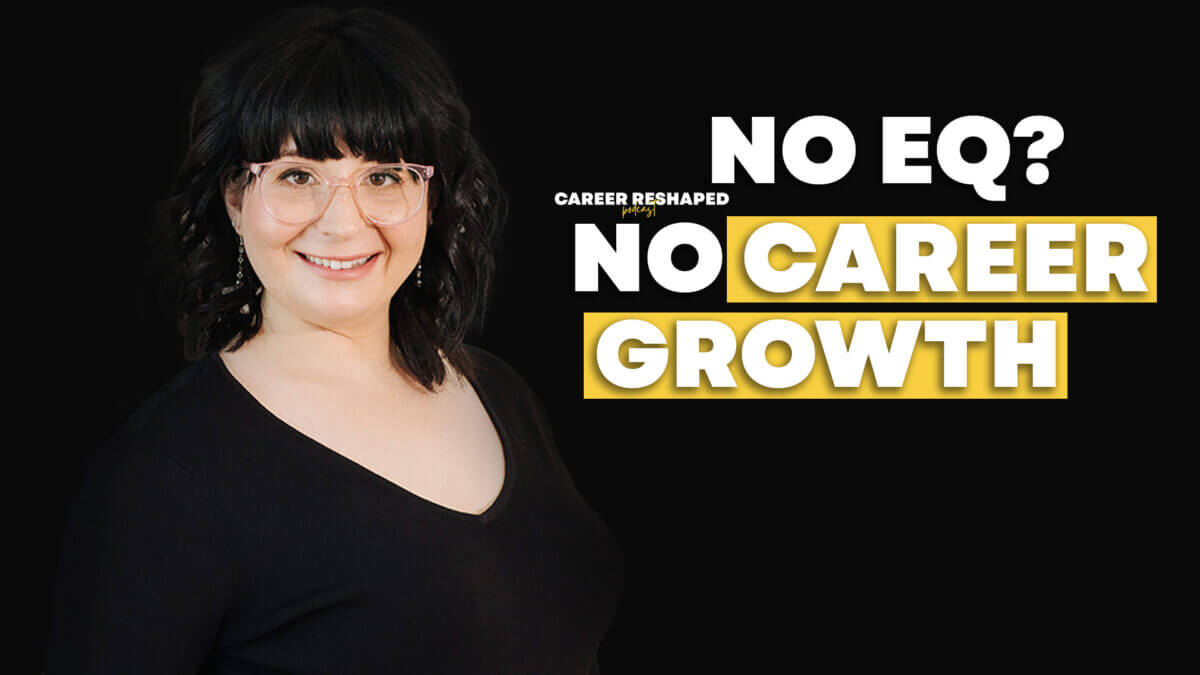
What if the real secret to a better career isn’t just about skills or experience, but about understanding people—including yourself?
In this episode of Career Reshaped, Pauline dives into emotional intelligence (EQ)—what it is, why it matters, and how it can transform not just your work, but your whole approach to career growth. You’ll hear why EQ is more than a personality trait, why it’s not taught in school, and why it’s often the “invisible skill” that helps people thrive in the workplace.
Pauline breaks down the five key elements of emotional intelligence: self-awareness, self-regulation, motivation, empathy, and social skills. She shares real examples of how these skills help people land jobs, grow as leaders, and even earn more (did you know people with high EQs can earn $29,000 more on average each year?). You’ll also discover why having a manager with high emotional intelligence can completely change your work environment for the better.
This episode is for anyone who’s ever wondered why some people seem to “read the room” effortlessly, handle stress gracefully, or inspire teams without being the loudest in the room. You’ll get practical questions to ask in job interviews to spot great managers, and tips to start building your own EQ—no matter where you are in your career.
If you’re ready to level up in work and life, tune in for a straight-talking conversation about why EQ is the game-changer your career needs.
🎧 Listen in for honest advice and real strategies to help you lead, listen, and show up as your best self—at work and beyond.
| Time | Transcript |
|---|---|
| 00:00 | Hi, I'm Pauline and I'm one of the career coaches with my career angels and |
| 00:03 | welcome back to our channel. Today I would like to talk to you about |
| 00:07 | emotional intelligence and why this is a very important skill to have as an |
| 00:15 | individual, but also why it's so important to work for a manager with |
| 00:21 | high emotional intelligence. So emotional intelligence is not taught at |
| 00:27 | school. It's not something that you can just pick up willy-nilly. It's not a |
| 00:33 | trait. It's not a personality type. It's something that you are born with. It's |
| 00:41 | innate within you. So, unfortunately, you either have it or you don't. And in |
| 00:50 | the real world, it often matters a lot more than you think. Sometimes emotional |
| 00:56 | intelligence can even be mistaken for street smart because it's someone that |
| 01:02 | is able to pick up the energy, read the |
| 01:05 | room, understand the vibe, be able to read other people quickly to scan and |
| 01:11 | understand how they are perceived, how they are how |
| 01:16 | others are feeling and adapt to the environments within them. So for |
| 01:23 | example, when it comes to employment, I have seen a lot of individuals go for |
| 01:29 | roles that they're not 100% qualified for and land the job because they are |
| 01:36 | calm under pressure because they are able to read the room. They can |
| 01:40 | understand what the hire manager is thinking and assessing and they can |
| 01:44 | adapt quickly. It's because they listen better. So listening is another great |
| 01:51 | skill when it comes to emotional intelligence because not just listening, |
| 01:56 | they're picking up. They're picking up the change in tone. They're picking up |
| 02:01 | in speed and they are picking up what they're being said. They're able to read |
| 02:06 | between the lines. It's not so black and white. They see the gray. And that that |
| 02:14 | is emotional intelligence at play. And if you are sitting here thinking, well, |
| 02:19 | I'm not good at emotional intelligence. Well, that's okay. It's not something |
| 02:24 | that you were taught. So, unless you were born with it, it's not something |
| 02:29 | that you'll be able to easily just adapt and pick up in your everyday life. So, |
| 02:36 | let's break down the five key aspects of emotional intelligence. |
| 02:42 | It is first selfawareness. You can't be emotionally intelligent if |
| 02:48 | you cannot be self-aware. The first person you need to be able to understand |
| 02:54 | and read is yourself. You might have overstepped the line |
| 02:59 | somewhere. If you aren't able to call yourself out, how can you even see how |
| 03:04 | others are reacting and responding? Self-regulation. |
| 03:09 | What does that mean? is basically the ability to keep your cool even when say |
| 03:15 | the person next to you maybe your manager is losing their minds. Now I |
| 03:21 | believe that I am someone with high emotional intelligence and even that is |
| 03:25 | something that I am still perfecting and practicing on. I'm not very good at |
| 03:29 | self-regulation. Whilst I'm self-aware and I can understand that I am |
| 03:34 | overreacting to simmer down those emotions is an art form and a skill in |
| 03:40 | itself but at least being able to identify it. You're halfway there. |
| 03:45 | Motivation doing the right thing even when no one's watching. You have a |
| 03:50 | conscious behind you. So you understand that your actions will have a |
| 03:55 | repercussion like a butterfly effect as you move forward in whatever project |
| 04:00 | steps actions that you take. Empathy. Now empathy is a big one because people |
| 04:05 | who are emotionally intelligent are aware of other people's feelings and |
| 04:09 | understand them. They can sympathize. They can empathize. They feel what |
| 04:14 | others are feeling. And social skills. The social skills pretty much wraps up |
| 04:20 | the whole entire emotional intelligence bubble. It is navigating conflict |
| 04:26 | without creating chaos. Is being able to walk the room, connect and meet with |
| 04:30 | people. Now, you don't need to be an extrovert to do that. One may think so, |
| 04:35 | but introverts are still able to read the room and still able to connect with |
| 04:40 | others. they they are just as skilled at doing this task as the next extrovert |
| 04:48 | out there. So whilst it's important to have this for |
| 04:54 | yourself to be able to improve your quality of life in the |
| 05:00 | workplace being able to adapt and understand what others around you are |
| 05:06 | saying are seeking. It is also really important to find a manager that is the |
| 05:12 | same. A manager with high emotional intelligence will support you, will |
| 05:18 | understand you, will be able to identify your emotions and moods and thinking and |
| 05:27 | thoughts and all of that to adapt to ensure that your working environment is |
| 05:34 | positive. but also expands in a way that aligns with your |
| 05:41 | abilities, goals, and so forth. Hey, it's Natasha, |
| 05:47 | and I'm Pauline. We're so pumped to bring you even bigger and better stuff |
| 05:51 | this season 2 of Career Reshaped. We've got new guests, free master classes, and |
| 05:57 | all the good vibes you'll only find here. So, don't forget to hit subscribe, |
| 06:01 | follow us on Spotify at career reshaped, and check us out on Instagram at |
| 06:06 | my.career.angels. So, let's just take one step back for a |
| 06:12 | second before I talk more on why you should seek a manager with emotional |
| 06:18 | intelligence, or in fact, how you should seek a manager with emotional |
| 06:22 | intelligence. I want to talk a little bit about the not just the key benefits |
| 06:26 | of emotional intelligence, but there's research that has been found. The |
| 06:30 | research from Talent Smart shows that people with a high EQ, so emotional |
| 06:37 | intelligence, earn $29,000 more per year on average. There's a |
| 06:45 | reason for that, and it's for everything that I've just talked about 3 minutes |
| 06:48 | ago. It's that with this ability, you're able to show another skill in the |
| 06:55 | workplace that is not taught at university, that you cannot read in a |
| 06:59 | book. It's about adapting to your environment and connecting with the |
| 07:05 | people around you. But then let's talk about why it's so important to find a |
| 07:10 | manager like this. Cuz a manager like this is one that you can trust. Is that |
| 07:13 | you can feel safe around, you can feel heard and understood. They don't have to |
| 07:19 | be the loudest in the room, but they're the clearest. They're the leaders, and |
| 07:25 | they are the best part of a team because not everyone around us has emotional |
| 07:32 | intelligence. It's a fact. So, we are not looking for the loudest person. |
| 07:37 | We're not even looking for the bubbliest person. As I said, it doesn't have to be |
| 07:42 | extroverts who are emotionally intelligent. It's the energy, the |
| 07:46 | presence, the tone, the understanding, the ability to connect with someone in |
| 07:54 | that instant environment. Even if there's an energy shift, they pick it |
| 07:58 | up. Like I said, it's reading the room. How do you know if your manager has |
| 08:05 | emotional intelligence? So when you are going for a new job role, how can you |
| 08:11 | identify if the manager that is sitting across from you is one with high |
| 08:16 | emotional intelligence? Good question. It's about the connection that you have |
| 08:22 | in that moment, but it's also about asking the right questions. |
| 08:29 | So questions such as how do you provide feedback and criticism to your |
| 08:35 | employees? How do you support your employees career growths? If there's |
| 08:40 | conflict within the team, how do you manage and support this conflict? What |
| 08:46 | are your expectations of the team? And what role do you play within the team to |
| 08:53 | achieve the various projects or tasks required? You'll be able to see by the |
| 08:59 | body language, the tone, and the answers whether this is a manager who's adaptive |
| 09:04 | and supportive and tries to understand the team and the complexities within |
| 09:10 | their various personalities or someone that has very strict and rigid |
| 09:16 | set of rules that everyone needs to comply to regardless. So end of the day, |
| 09:21 | emotional intelligence is intelligence and it's something that is definitely |
| 09:26 | missing in the workplace a lot. So at my career angels, we support individuals in |
| 09:32 | their career, providing advice on how to elevate and build their careers. So it's |
| 09:38 | not just resume writing, but it is rebuilding confidence. It is guiding, |
| 09:44 | mentoring, providing you with insider information, tips and tricks in how to |
| 09:50 | grow, develop, and what to look for in yourself as well as the people you're |
| 09:55 | working with. We are here to rewire the communication and show you how to own |
| 10:04 | the room even on a Zoom call. And if this has resonated, stick around. This |
| 10:09 | is the kind of conversations we are always having here on career reshapes |
| 10:14 | because your future role doesn't care about your old title. It cares about how |
| 10:20 | you lead, how you listen, and how you how up for yourself and for your team. |
| 10:29 | And that's well that's a skill that you can start sharpening right now. See you |
| 10:35 | next time. |



Take the first step toward a smarter, more effective job search with The Unseen Advantage. This ebook is designed for job seekers who are ready to move past outdated methods, create genuine opportunities, and position themselves as the candidate employers are looking for.
When you take time to reflect on your career and align it with your values, you’re not only investing in your own growth — you’re creating a ripple effect that impacts your family, your workplace and your wellbeing.
Whether you’re feeling stuck, ready for change, or simply craving more purpose in your work, Career Coaching can help you move forward with clarity and confidence.
Start your Next Chapter Today!